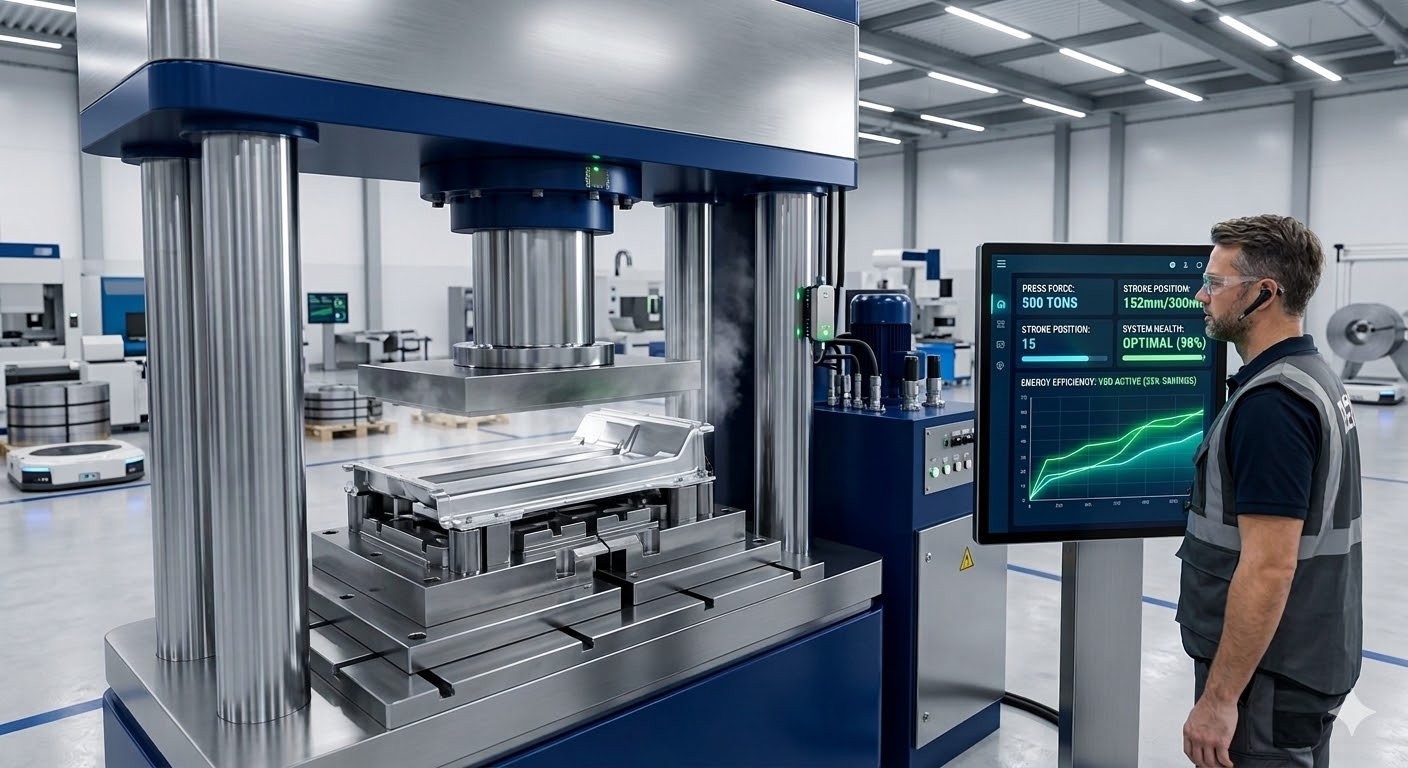
The manufacturing landscape of 2026 looks vastly different than it did even a decade ago. We have moved beyond the era of simple mass production into an age defined by hyper-customization, extreme material strength, and digital transparency. At the center of this seismic shift is a machine that has been a shop staple for over two centuries, now reborn for the digital age: the hydraulic press.
Far from being a “legacy” technology, the modern hydraulic press has undergone a massive evolution. By integrating Internet of Things (IoT) connectivity, advanced manifold designs, and sustainable power management, these machines are now the primary drivers of efficiency in modern factory settings.
In this comprehensive look, we explore how hydraulic presses are revolutionizing the manufacturing industry, why they are outperforming traditional mechanical alternatives, and how they are helping companies meet the rigorous demands of the 2026 global market.
1. The Intelligence Shift: IoT and Data-Driven Manufacturing
The most significant revolution in hydraulic technology is the move toward Smart Manufacturing. In 2026, a hydraulic press is no longer a “blind” machine; it is a sophisticated data hub.
Predictive Maintenance and Uptime
In the past, a blown seal or a pump failure could shut down a production line for days. Today, integrated sensors monitor every vital sign of the press—from oil temperature and viscosity to vibration patterns and pressure fluctuations.
- Real-Time Diagnostics: Operators can now view the “health” of their machine on a tablet or centralized dashboard.
- AI-Driven Alerts: Machine learning algorithms analyze historical data to predict when a component is likely to fail, allowing for maintenance to be scheduled during planned downtime.
Process Optimization
With CNC (Computer Numerical Control) integration, hydraulic presses can now store thousands of “recipes.” This allows for near-instantaneous changeovers. Whether a manufacturer is switching from a heavy gauge steel automotive frame to a delicate aluminum housing, the press adjusts its pressure, speed, and dwell time automatically, ensuring the first part of a new run is as perfect as the last.
2. Versatility: The “One Machine” Solution
One of the primary reasons hydraulic presses are dominating the market is their inherent flexibility. Unlike mechanical presses, which are often limited by a fixed stroke and a specific tonnage curve, hydraulic systems offer infinite adjustability.
Full Tonnage at Any Point
In a mechanical press, the maximum force is only available at the very bottom of the stroke. This is a massive limitation for deep drawing or complex molding.
The Hydraulic Advantage: A hydraulic press provides its full rated tonnage throughout the entire stroke. This allows manufacturers to handle deeper draws and more complex geometries without needing to invest in larger, more expensive mechanical equipment.
Adjustable Stroke and Speed
Because the ram movement is controlled by fluid dynamics rather than a physical crankshaft, the stroke length can be adjusted to the millimeter. This reduces “air time” (the time the ram spends moving without hitting the workpiece), significantly increasing parts-per-hour without increasing the physical speed of the machine.
3. The Green Revolution: Energy Efficiency and Sustainability
As global regulations on carbon footprints tighten in 2026, manufacturers are under immense pressure to reduce energy consumption. Hydraulic presses have answered this call through radical engineering shifts.
Power-on-Demand Technology
Traditional hydraulic systems kept pumps running at high speeds constantly, wasting immense amounts of electricity. Modern systems utilize variable-speed drive (VSD) technology. The motors only spin at the speed required for the specific phase of the cycle. When the press is idling or holding pressure, energy consumption drops to near zero.
Heat Reduction and Longevity
By optimizing fluid flow through 3D-printed manifolds and high-efficiency valves, modern presses generate significantly less heat. This leads to two major benefits:
- Lower Cooling Costs: Less energy is spent on massive heat exchangers or cooling towers.
- Longer Component Life: Hydraulic oil stays within its optimal thermal range longer, preventing the premature breakdown of seals and valves.
4. Safety and Ergonomics in the Modern Workspace
The “greasy, loud, and dangerous” reputation of the old-school machine shop is being erased by the clean, quiet operation of modern hydraulic systems.
- Noise Reduction: New pump designs and dampened mountings have brought decibel levels down to a point where operators can communicate without shouting, improving the overall safety of the shop floor.
- Advanced Light Curtains and Interlocks: 2026 safety standards are integrated directly into the press’s logic. If a light curtain is breached, the hydraulic system can dump pressure instantly, stopping the ram faster than any mechanical brake ever could.
- Ergonomic Loading: Many hydraulic presses are now designed with modular heights and automated shuttle tables, reducing the physical strain on human operators and allowing for easy integration with robotic arm loaders.
5. Industry-Specific Revolutions
The impact of these advancements is felt across diverse sectors:
The Electric Vehicle (EV) Sector
EVs require lightweight structural components to offset battery weight. Hydraulic presses are essential for hot stamping and forming high-strength, low-alloy (HSLA) steels that are too tough for conventional mechanical stamping.
Aerospace and Defense
With the rise of private space exploration, the demand for large, complex titanium and composite parts has surged. The precision control of a hydraulic press allows for the slow, steady pressure required to form these exotic materials without causing structural micro-fractures.
Consumer Electronics
As devices get thinner and more durable, the enclosures require extreme precision. The ability of a hydraulic press to “dwell”—holding a specific pressure for a set time—ensures that metal flow is perfectly consistent, resulting in the sleek, seamless finishes consumers expect.
Comparison: Hydraulic vs. Mechanical (2026 Landscape)
| Feature | Modern Hydraulic Press | Traditional Mechanical Press |
| Tonnage | Consistent throughout stroke | Only at bottom of stroke |
| Setup Time | Minutes (Digital presets) | Hours (Manual die adjustment) |
| Maintenance | Predictive / Low wear | Reactive / High mechanical friction |
| Noise Level | 70-75 dB (Quiet) | 85-100+ dB (Loud) |
| Versatility | High (Multi-purpose) | Low (Single-purpose) |
6. The Bottom Line: Why Manufacturers are Switching
The revolution isn’t just about the technology—it’s about the Return on Investment (ROI). While the initial cost of a high-tech hydraulic press may be comparable to other systems, the long-term savings in energy, the reduction in scrap parts through better precision, and the ability to take on a wider variety of contracts make it the superior financial choice for 2026.
The ability to “future-proof” a facility with a machine that can be updated via software rather than replaced via hardware is a game-changer for the manufacturing industry.
Conclusion: Shaping the Future
The hydraulic press has successfully transitioned from a symbol of the Industrial Revolution to a cornerstone of the Digital Revolution. By combining raw power with surgical precision and eco-conscious engineering, it remains the most versatile tool in the manufacturer’s arsenal.
As we look toward the remainder of the 2020s, the companies that thrive will be those that embrace these “intelligent” workhorses to drive their production lines forward.