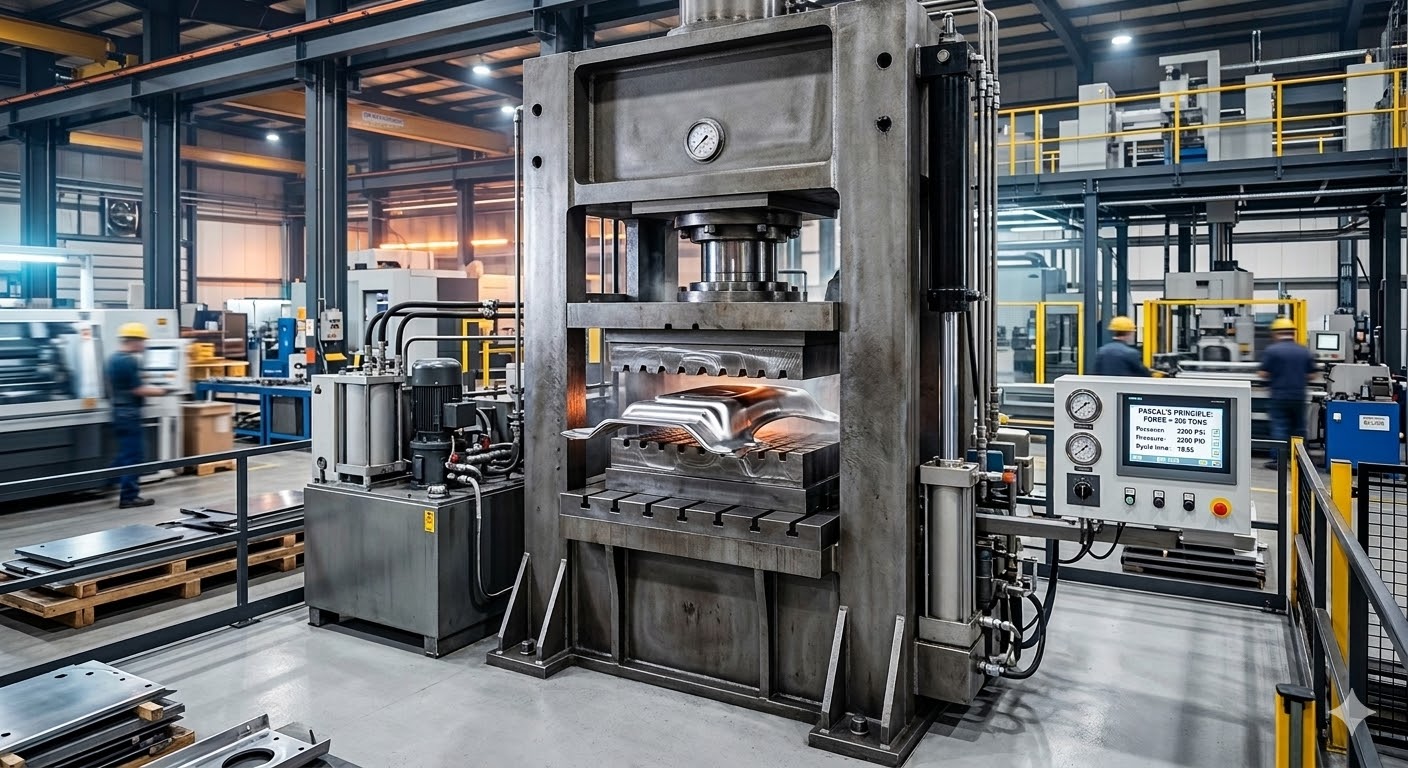
In the high-stakes world of industrial production, where precision meets power, one machine stands as the undisputed titan of the shop floor: the hydraulic press.
From the sleek body panels of the latest electric vehicle to the intricate components of a smartphone, the hydraulic press is the silent architect of our modern world. But what makes this centuries-old concept so indispensable in the era of AI and robotics? In this comprehensive guide, we dive deep into the mechanics, applications, and future of the hydraulic press.
1. What is a Hydraulic Press?
At its core, a hydraulic press is a machine that uses a hydraulic cylinder to generate a compressive force. It operates based on Pascal’s Principle, which states that pressure exerted anywhere in a confined incompressible fluid is transmitted equally in all directions throughout the fluid.
By applying a small amount of force to a small area, the system can generate a massive amount of force over a larger area. This mechanical advantage allows a hydraulic press to crush, shape, mold, and stamp materials with a level of control and power that mechanical presses struggle to match.
The Basic Components
- The Main Cylinder: The powerhouse where hydraulic energy is converted into mechanical force.
- The Hydraulic Pump: The “heart” that moves the oil through the system.
- The Control Valves: The “brain” that regulates the direction and pressure of the fluid.
- The Bolster and Ram: The physical surfaces that come into contact with the workpiece or die.
2. The Science Behind the Strength: Pascal’s Law
To understand why these machines are so effective, we have to look at the math. The fundamental equation governing hydraulic systems is:
P = F / A
Where P is pressure, F is force, and A is the cross-sectional area. Because the pressure P remains constant throughout the closed system, a small force applied to a small piston (A1) result in a significantly larger force at a larger piston (A2):
F2 = F1 X (A2\A1)
This allows a relatively small motor to generate hundreds, or even thousands, of tons of force.
3. Types of Hydraulic Presses and Their Roles
Not all hydraulic presses are created equal. Depending on the manufacturing requirement, engineers choose specific frames and configurations.
| Type | Best For | Key Advantage |
| H-Frame Press | Heavy-duty maintenance and assembly | Robust design, handles high tonnage |
| C-Frame Press | Stamping, punching, and assembly | Saves floor space, easy access from three sides |
| Four-Column Press | High-precision molding and die-striking | Equal pressure distribution across the plate |
| Arbor Press | Small-scale tasks like installing bearings | Hand-operated, high precision for light work |
4. Why Hydraulic Wins: The Advantages in Manufacturing
Why has the hydraulic press remained the backbone of industry for so long? The answer lies in its versatility and reliability.
Full Power Throughout the Stroke
Unlike mechanical presses, which only reach their peak force at the very bottom of the stroke, a hydraulic press can deliver full tonnage at any point in its travel. This is crucial for deep drawing or molding processes where consistent pressure is required.
Built-in Overload Protection
If a hydraulic press hits its pressure limit, a relief valve opens. It won’t break its own frame or shatter a die—it simply stops. This makes it significantly safer and more cost-effective in terms of maintenance compared to its mechanical counterparts.
Flexibility and Control
Modern hydraulic presses allow operators to control:
- Pressure: Exact force application to avoid material fatigue.
- Dwell Time: Holding pressure for a specific duration (vital for plastics and composites).
- Speed: Adjusting the ram speed to suit delicate materials.
5. Applications Across Industries
If you look around your room, chances are a hydraulic press helped make something you’re touching.
Automotive Industry
This is perhaps the biggest consumer of hydraulic technology. Massive presses stamp out hoods, doors, and chassis components. Smaller presses are used for “interference fits”—pressing bearings into housings or gears onto shafts.
Aerospace and Defense
In aerospace, materials like titanium and high-strength alloys require immense, controlled pressure to shape. Hydraulic presses are used to create structural ribs for wings and engine housings that must withstand extreme atmospheric conditions.
Agriculture and Construction
From the heavy steel blades of a plow to the structural beams of a skyscraper, the hydraulic press is responsible for the heavy lifting of the infrastructure world.
Electronics and Consumer Goods
Ever wonder how the battery in your phone is so compact? High-precision hydraulic presses are used to compress powdered chemicals into tablets or compact layers of lithium-ion cells.
6. Maintenance: Keeping the Titan Running
A hydraulic press is a long-term investment, often lasting 30 to 50 years if properly maintained.
- Fluid Health: 80% of hydraulic failures are due to contaminated oil. Regular filtration and oil changes are non-negotiable.
- Seal Integrity: High pressure eventually wears down rubber and polymer seals. A “weeping” cylinder is a sign that a major failure is imminent.
- Heat Management: Hydraulic systems generate heat. If the oil gets too hot, it loses viscosity, leading to sluggish performance and damaged pumps.
7. The Future: Industry 4.0 and Smart Hydraulics
The “dumb” iron of the past is getting a digital brain. The latest generation of hydraulic presses features:
- IoT Integration: Sensors that monitor vibration, temperature, and pressure in real-time to predict failures before they happen (Predictive Maintenance).
- Servo-Hydraulics: Combining the power of hydraulics with the precision of electric servo motors, reducing energy consumption by up to 40%.
- Digital Twins: Simulations that allow engineers to test a “press run” virtually before ever touching a piece of metal.
Conclusion: The Unstoppable Force
The hydraulic press is far more than just a “crushing machine.” It is a precise, controllable, and incredibly powerful tool that has adapted to every industrial revolution. As we move toward more sustainable and high-tech manufacturing, the hydraulic press will continue to evolve, remaining the essential backbone of global production.
Whether you are a small shop owner or a plant manager at a global OEM, understanding the power of hydraulics is key to mastering modern manufacturing.