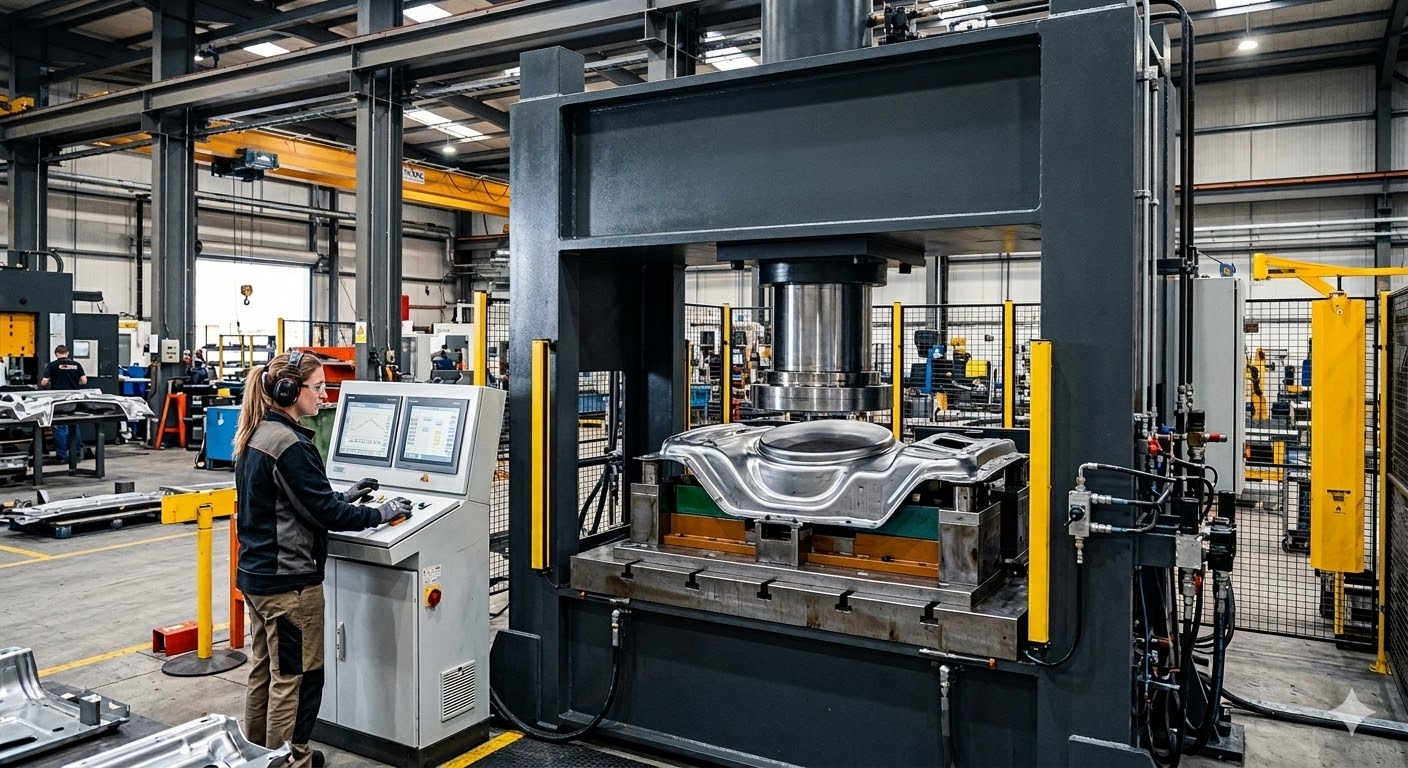
In the modern industrial landscape, the ability to shape, mold, and compress materials with absolute precision is what separates a standard workshop from a world-class manufacturing facility. At the heart of this capability lies the hydraulic press.
From the automotive components in your car to the structural beams in high-rise buildings, hydraulic presses are the silent workhorses of the metal forming industry. This guide explores why these machines remain indispensable, the science behind their power, and how they drive efficiency in global manufacturing.
1. What is a Hydraulic Press?
A hydraulic press is a machine that uses a hydraulic cylinder to generate a compressive force. It operates based on Pascal’s Principle, which states that pressure exerted anywhere in a confined incompressible fluid is transmitted equally in all directions throughout the fluid.
How it Works: The Science of Power
By applying a small amount of force to a small piston (the “plunger”), the pressure is transferred through the hydraulic fluid (usually oil) to a larger piston (the “ram”). This allows the machine to generate massive amounts of force—ranging from 1 ton to over 50,000 tons—with minimal input.
2. Key Advantages of Hydraulic Presses in Metal Forming
Why do manufacturers choose hydraulic systems over mechanical or manual alternatives? The benefits go beyond simple power.
Full Power Throughout the Stroke
Unlike mechanical presses, which only reach their peak force at the very bottom of the stroke, a hydraulic press can deliver full tonnage at any point in the ram’s travel. This is crucial for deep drawing processes where consistent pressure is required from start to finish.
Built-in Overload Protection
If a mechanical press exceeds its capacity, it can “jam” or break a die. Hydraulic presses are equipped with relief valves. Once the pressure reaches a pre-set limit, the valve opens, preventing the machine from exceeding its structural limits. This saves thousands of dollars in potential tooling repairs.
Versatility and Customization
Hydraulic presses are remarkably adaptable. A single machine can be used for:
- Deep Drawing
- Punching and Blanking
- Stamping
- Straightening
- Forming and Molding
Lower Operating Costs
Modern hydraulic systems are designed for longevity. With fewer moving parts than complex mechanical linkages, they require less frequent maintenance and offer a lower “cost per part” over the machine’s lifecycle.
3. Types of Hydraulic Presses and Their Applications
Choosing the right press depends on the specific requirements of your production line.
| Press Type | Best For… | Key Feature |
| H-Frame Press | Heavy-duty industrial tasks | Rugged, open-sided design for large parts |
| C-Frame (Gap) Press | Small to medium parts | Saves floor space; provides three-side access |
| Four-Post Press | High-precision molding | Ensures perfectly even pressure distribution |
| Horizontal Press | Straightening and bending | Ideal for long bars or structural beams |
4. The Role of Precision in Modern Manufacturing
As industries like aerospace and medical device manufacturing evolve, the margin for error has shrunk to microns. Hydraulic presses have adapted by integrating CNC (Computer Numerical Control) systems.
Precision Control of Pressure and Speed
With digital interfaces, operators can program specific “dwell times” (holding pressure for a set duration) and ram speeds. This level of control ensures that sensitive metals do not crack during the forming process and that the final product meets exact specifications every time.
5. Improving Efficiency with Hydraulic Technology
In a competitive market, efficiency is the key to profitability. Here is how high-quality hydraulic machinery optimizes your workflow:
- Reduced Scrap Rates: Consistent pressure leads to fewer defects.
- Energy Efficiency: Variable displacement pumps ensure the motor only works as hard as necessary, reducing electricity costs.
- Rapid Die Changes: Modern hydraulic presses often feature quick-die-change systems, reducing downtime between different product runs.
6. Safety Standards in Metal Forming
Safety is paramount when dealing with thousands of tons of force. Modern hydraulic presses include:
- Light Curtains: Infrared sensors that stop the machine if an object enters the work zone.
- Dual Palm Buttons: Requiring the operator to use both hands to initiate the stroke, keeping limbs clear of the ram.
- Interlocked Guards: Physical barriers that must be closed for the press to operate.
7. Future Trends: Industry 4.0 and Hydraulics
The future of metal forming is “smart.” We are seeing the rise of:
- IoT Integration: Sensors that monitor oil temperature and pressure in real-time to predict maintenance needs.
- Servo-Hydraulic Hybrids: Combining the speed of electric motors with the raw power of hydraulics for the ultimate “best of both worlds” machine.
Conclusion: Investing in the Right Solution
The importance of the hydraulic press in metal forming cannot be overstated. It is the backbone of industrial production, providing the power, precision, and versatility needed to create the products the world relies on.
For businesses looking to scale their production and ensure the highest quality output, choosing a reliable partner for machinery is the most critical step.